
Fair Trade
What is Fair Trade?
Fairtrade is a commercial relationship that promotes more equality in international commerce via conversation, transparency, and respect. It supports to long-term development by improving trading conditions and protecting the rights of marginalized producers and employees, particularly in the South.



Femmake is a Fair Trade fashion pioneer and a FAIRTRADE certified licensee. This means that Fair Trade-certified items are fair trade certified across the supply chain. We strive for the highest Fair Trade standards on programs to help our producers, such as hand skills training, the development of natural and low-impact dyes, and organic cotton cultivation, through tight relationships.
Fair Trade Principles Obeyed by Femmake
The World Fair Trade Organization (WFTO) has developed 10 Principles of Fair Trade that serve as a framework for the practices of its member organizations. Femmake is committed to upholding these principles in all areas of its operations and strives to set an example for other fair trade organizations globally.

Principle One: Creating Opportunities for Economically Marginalised Producers
Femmake aims at raising public awareness of female artisans by providing opportunities for those in developing countries whose financial status is extremely low.
Principle Two: Transparency and Accountability
Femmake values transparency and accountability in its management and commercial relationships. Femmake actively involves female artisans in decision-making and ensures they receive relevant information. Communication channels are open and effective across all levels of the supply chain.
Principle Three: Fair Trading Practices
Femmake trades with concern for the social, economic, and environmental well-being of female artisans in developing countries and does not maximize profit at their expense. It is responsible and professional in meeting its commitments in a timely manner. Artisans respect contracts and deliver products on time and to the desired quality and specifications.
Principle Four: Fair Payment
The aim ofFemmake is payment of a Local Living Wage to artisans. A Local Living Wage provides remuneration sufficient for a decent standard of living for the artisan and family, for a work week no more than 48 hours. Femmake ensures Fair Payment including Fair Prices and Fair Wages. Fair Prices represent an equitable share to each artisan and include fair profit. Fair Wages are equitable, negotiated pay of at least a Local Living Wage.
Principle Five: Ensuring no Child Labour and Forced Labour
Femmake adheres to the UN Convention on the Rights of the Child, and national / local law on the employment of children. Femmake ensures that there is no forced labour in its workforce and / or members or homeworkers.
Principle Six: Commitment to Non Discrimination, Gender Equity and Women’s Economic Empowerment, and Freedom of Association
Femmake adheres to the UN Convention on the Rights of the Child, and national / local law on the employment of children. Femmake ensures that there is no forced labour in its workforce and / or members or homeworkers.
Principle Seven: Ensuring Good Working Conditions
Femmake provides a safe and healthy working environment for female artisans and/or members. It complies, at a minimum, with national and local laws and ILO conventions on health and safety.
Principle Eight: Providing Capacity Building
Femmake seeks to increase positive developmental impacts for small, marginalised producers through Fair Trade. Femmake also develops the skills and capabilities of our own artisans.
Principle Nine: Promoting Fair Trade
Femmake raises awareness of the aim of Fair Trade and of the need for greater justice in world trade through Fair Trade. We advocate for the objectives and activities of Fair Trade according to the scope of Femmake.

Principle Ten: Climate Action and Protection of the Environment
Fair Trade Organisations support and practice production, agriculture, service, and trade activities that are natural resource conserving, low-emitting, culturally sensitive, socially just, and economically viable.
Femmake’s Artisans Investment Model
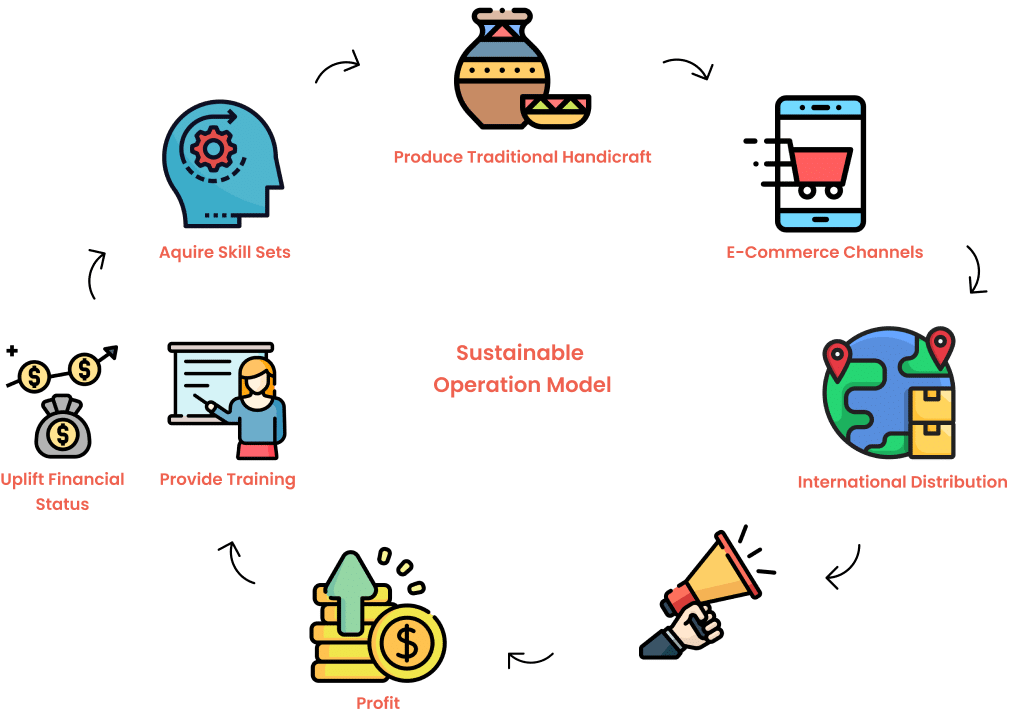
Femmake is sourcing all our traditional handicrafts from female artisans. Their handicrafts will be distributed worldwide via e-commerce. The trading will be carried out on the e-commerce platform to reach international customers, so we can promote female artisans as well as their creations. We will pay fair wages to female artisans so that they can achieve financial independence, be more powerful in society, and advance gender equality. Part of the profits will be contributed to the local organization and women s shelter to train and support women and artisans so that they can acquire skill sets, then we can receive more handicrafts.